
GMAT practice tests
GMAT practice tests are an essential step in creating a coherent gmat study plan. You must strike a balance between familiarizing yourself with the content of the exam, and not taking too long to take that first mock test.
Here is a guide on how to take your first GMAT practice test and what to do before
How many official gmat practice tests are there?
There are 6 official GMAT mock tests. 2 are free and 4 that you can buy separately, or in packs of two or four.
Where to find the official GMAT practice tests
You can buy them in a pack of 4 here
Should you buy the 4 extra gmat practice tests?
Absolutely. They will be worth every penny, BUT, to derive the most value you can out of them give yourself the opportunity to improve first. Purchase the gmat practice tests only after you have analyzed your failures on your last practice test. Put in at least another 40 hours of solid practice, targeting any weaknesses in your foundations or reasoning process between practice tests.
You can purchase the gmat practice tests in packs of 2 or 4.
Of course, the GMAT is big business and GMAC’s main objective from this is to make money. Don’t let this sway you away from buying the tests. Instead of buying the CATs of test prep companies, buy these two tests because:
- No CAT test that you can buy from a prep company can simulate the computer adaptive testing environment as the official CAT can. That’s just common sense. Furthermore, the scoring algorithm is the same as the real one on test day and no test prep company on the market comes close to replicating it.
- Official practice tests are an excellent predictor of the score you will get on the real test. Almost every one of my students scores within +/- 10 points of their last practice test score.
- Practice makes perfect, and good practice with relevant material is even more perfect.
The key to improving
They key to improving and scoring well on the GMAT is not by doing 10s of practice tests, but by identifying your weaknesses, creating a study plan and sticking to it, and practicing with official GMAT questions. In addition to questions in the official guides, practice includes taking CAT tests throughout the duration of your preparation to gauge your performance and improvement. Six practice tests will be more than enough to do that.
How to use the official GMAT mock tests
A major faux pas of preparation is going through the mock tests really fast. You should only take a mock test when you have made a substantial to your performance by either putting in at least 30 to 40 hours of preparation, or based on the assessment of a tutor.
Can you repeat the GMAT mock tests?
Yes, but you may see repeated questions, especially for tests 3,4,5, and 6, as the pool of questions in each is smaller than in free tests 1 and 2.
Here is how you can repeat a mock test and get a good estimate of your score
If you see a question you had seen before
- Make sure you stay on that question 2 minutes whether you know the correct answer or not.
- Only choose the correct answer if you can prove it. If you cannot prove it by 2 minutes, enter the wrong answer.
This helps you make it as representative of a brand new mock test as possible and avoid inflating your score.
GMAT mock tests timing guideline
You should take mock tests under exam conditions. This is non-negotiable. If you start a mock test, you must finish it. You can use this timing table to pace yourself during the mock test (and real test) to make sure you keep a good pace and not run out of time.
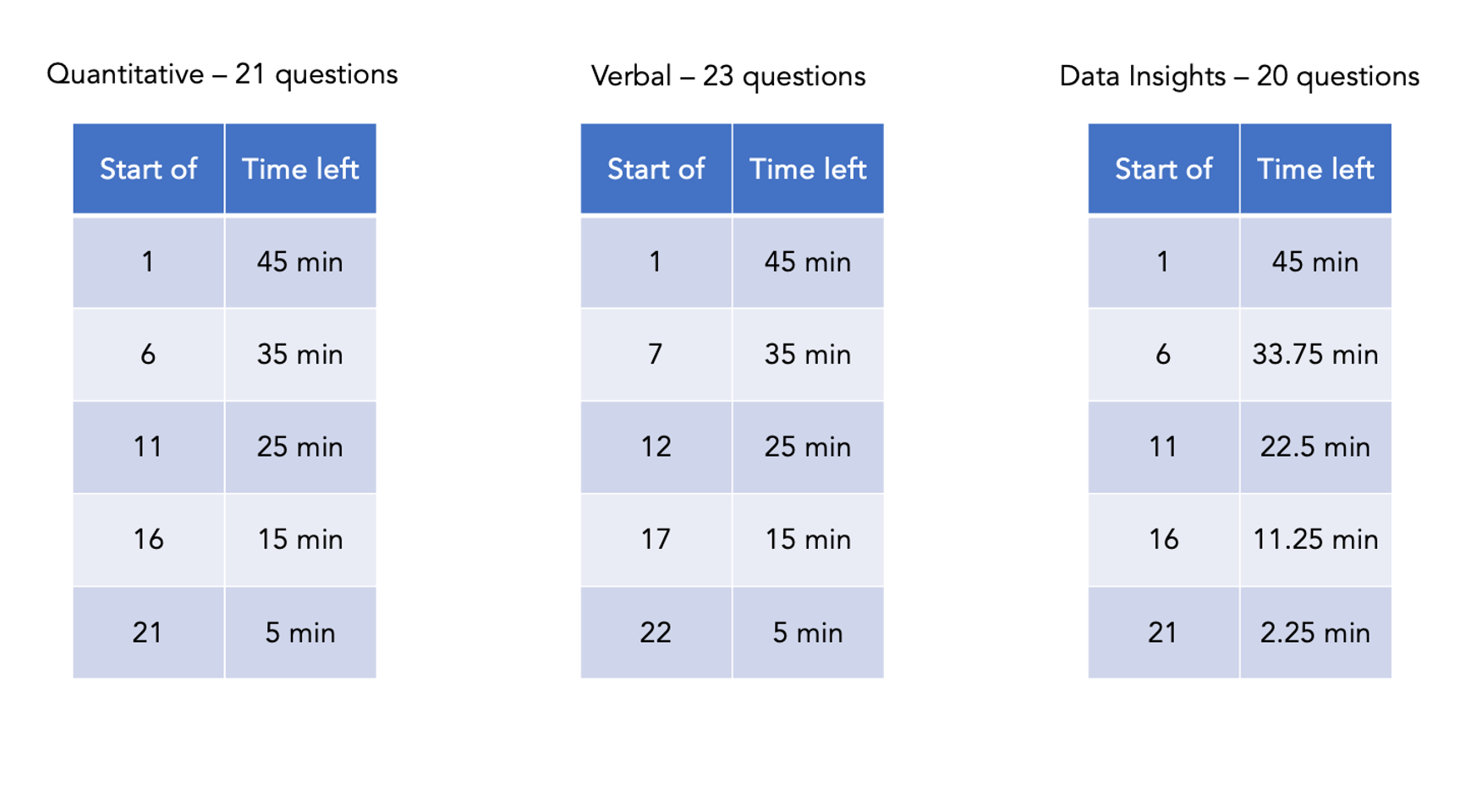
Note that this is a guideline. Your goal is to keep a good pace so use it as a benchmark. It is ok to be a little behind the checkpoint, but you must not allow the time lost to build up. As for Data Insights, it is important to aim for solving data sufficiency questions in about 1.5 minutes / question to have more timing for longer DI ones, but also to plan on guessing 2 or 3 questions. This timing strategy helped a lot of candidates improve their score.