Why Is GMAT Quant So Hard?
Nobody really tells you this when you start to study for the GMAT: The single biggest determining factor for how easy your preparation is going to be is your educational background. To be precise, what you actually did up to your high school. By the time you reached the age of 15, what you did—that is what determines how easy the GMAT is going to be.
Key Takeaways
- Your educational background before age 15 is the biggest factor determining GMAT quant difficulty
- Four levels must be mastered: Foundations → Concepts → Reasoning (translation/autonomy) → Efficiency
- Foundations must be automatic (low cognitive load)—if you’re slow with basics, you’re too slow for the GMAT
- Skills acquired as an adult regress quickly if you stop practicing—consistency is critical
- Progress is not linear—each level builds on the previous, and weakness in one limits what you can achieve in the next
- The 90th percentile timeline depends entirely on your starting point and educational foundation
The Brutal Truth About Educational Background
Let me be specific. We’re going to talk about GMAT quant. There are three things—actually four—that you have to do to be really good at math and to solve difficult questions in two minutes or less.
What you did in your work experience as an adult matters. What you did in your undergrad education matters more. But the absolute most important factor is what you did in your adolescent years up to high school. That is the single biggest determinant of how easy it is going to be for you to do really well on GMAT quant.
Level 1: Foundations—The Basics of Mathematics
Your foundation and your understanding of the basics of mathematics has to be impeccable. It has to be so strong and so assimilated that you don’t really need to think about the rules of why numbers behave the way they do.
The 2 to the Power of 9 Test
For example, if I ask you: What is 2 to the power of 9 times 3?
Are you quickly and without a lot of effort able to tell me: Well, 2 to the power of 9 is 512, and when I multiply that by 3, that is the same as multiplying 500 by 3, which is 1,500, and multiplying 12 by 3, which is 36, and then adding these numbers back together to tell me that it’s 1,536.
If you’re able to do that immediately on autopilot without having to expend a lot of energy—meaning low cognitive load in your mind—if you can do that really fast, that is excellent. You’re in good shape.
If you can’t do that and you have to think about it for a very long time, and you have to take out a pen and paper (and there’s no shame in that) and write it down, you’re too slow for the purposes of the GMAT. You need to spend a lot of time working on foundations.
How Much Time Will It Take?
You may ask me: How much time? And I will tell you—and you may hate this—it depends. This chart shows probable prep time to 645+ by starting score.
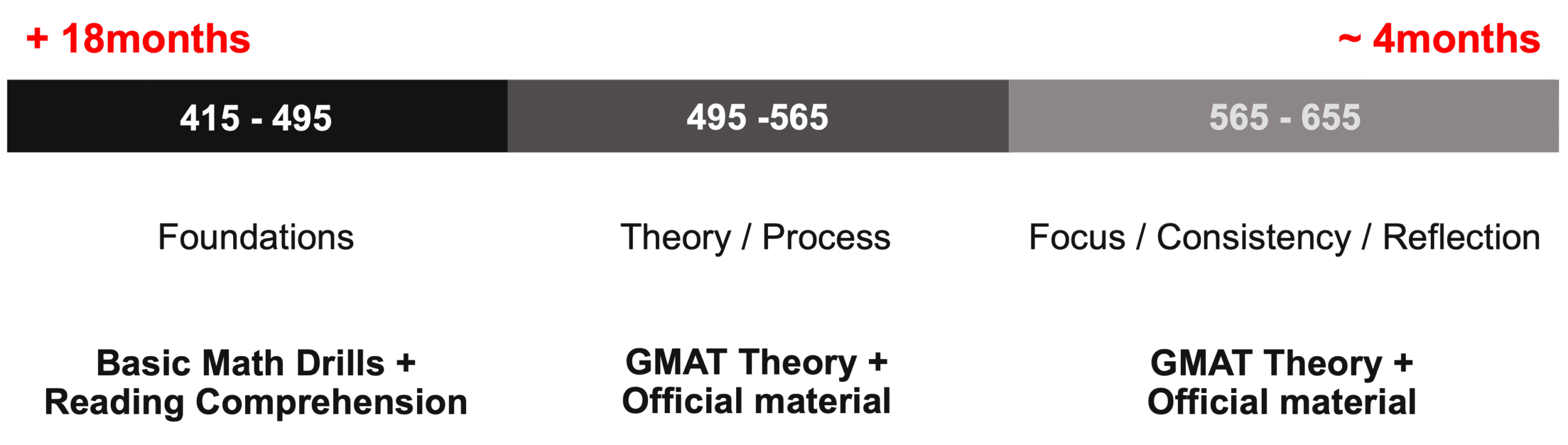
Here’s what makes this really very complicated: When you spend a lot of time improving these foundations (and that is going to be required in your case), then you actually develop the ability and you become better and faster. You begin to do it without thinking much about it.
But it is very easy to regress if you let it go.
Because it is a skill that you’re acquiring when you’re older, if you let it go, it’s going to recede. That is a complicating factor. That is why a lot of people struggle with the GMAT. They make some progress on the foundations and then they just let them go. There’s a regression.
That explains sometimes why progress takes time, but then sometimes your score increases but then drops—because you stop targeting those foundational skills that are required.
What Are Foundational Skills?
These foundational skills—the basics of math—what are they?
Number one: Number sense. Do you appreciate and understand the difference between integers, decimals, fractions, percentages? If you’re looking at the number line, are you able to find your way around the number line? Do you understand what happens between 0 and 1, minus 1 and 0? Do you understand roots, squares, etc.? Are you able to appreciate the relative size of numbers?
For example, if I divide 1 by 10 to the minus 8, do you understand and appreciate that that is a huge number?
These are really very important things that are related to the foundations of mathematics.
Why Skills Regress Faster as an Adult
When you build these foundations and continuously revisit these concepts and these levels as you move on to other skills, if you let them go, you will recede. And it recedes faster as an adult.
These are the complications. That is why when you’re preparing for the GMAT, it is so important to have your life in order and to have the time to put in, to be consistent, to build momentum and keep your rhythm. Because when you stop, you recede.
Level 2: Concepts—Understanding Profoundly
The second thing you have to do to be better at mathematics is to understand the concepts profoundly well.
Understand the following: Every step builds on the previous step.
If you have a weakness at a foundational level, it is going to limit what you can understand in concepts. If you have a weakness in your understanding of concepts, it’s going to limit what you can understand and achieve at the reasoning level.
You have to have a very strong foundation. You have to have a very strong understanding of concepts in order to build on the subsequent levels.
What Concepts Does the GMAT Test?
When you’re thinking about concepts, what are the concepts that they really test on the GMAT? It’s not a lot. They classify them as follows:
- Value, order, and factors
- Rates
- Ratios and percentages
- Algebra and inequalities
- Statistics
- Probability
- Sequences and series
Under each one of them, there are a few more concepts. Your understanding of these concepts needs to be absolutely impeccable. You have to understand them on a profound level.
Little Snippets and Principles
As I said earlier, these concepts are not very difficult. They are not many. But there are little snippets, principles, that are a part of every one of those concepts that you have to know really well.
Let me give you an example: If I tell you that you divide an integer by four, do you understand immediately that the remainder can be no larger than three?
Or if I tell you that two integers are consecutive, do you immediately infer that they cannot share any other factor than one?
These are important ideas that, number one, you have to understand. You have to be able to agree with them. But also, equally—if not more importantly—you have to be able to summon them in the moment when you’re solving a question under time conditions.
Understanding vs. Summoning Under Pressure
There is a world of difference between seeing something—for example, a solution—and agreeing with it, versus being able to generate that solution using these very small principles under time conditions the first time you see a question.
There lies the difficulty.
These are the concepts that you have to understand, but you have to understand them profoundly well.
Level 3: Reasoning and Translation (Autonomy)
Let’s talk about the next step, which is described as follows: We would call it reasoning. Let’s talk specifically about quantitative reasoning.
Reading and Modeling
You’re reading a question. Are you able, as you read that question, to define a model that can represent that question in an equation?
For example, you’re reading a question. Do you recognize that this is work-rate-time? And then are you able to translate that question—these words that you’re reading—into a clear, concise equation?
As you’re reading that very long paragraph, are you able to recognize the various elements at play? For example, when we talk about work-rate-time, do you recognize: Okay, here’s the work, here’s the rate, here’s the time?
Invoking Reasoning Principles
Are you able to invoke some reasoning principles? For example, when they tell you that there are four machines with identical rate, can you say: Well, work equals rate times time, but in this case, it’s work equals nRT—number of machines times the rate per machine times the time.
Are you also able to invoke principles of reasoning where they tell you: If we double the work and keep the time the same, are you able to infer that you must double the rate? And to double the rate, you have to double the number of machines?
These are principles of reasoning that you invoke as you’re reading this long text. Then you recognize the elements at play (work-rate-time), and you’re able to describe that relationship (work equals rate times time), and then to identify the unknown and assign it a variable, and then to recognize that that is a variable you have to solve for.
That is the third level.
What Is Autonomy?
We have foundations, then we have concepts, then we have this idea of translating by using our understanding of the concepts and principles of quantitative reasoning. This requires what I would call autonomy.
I wrap it with an idea that I call autonomy in the sense that you are able to do that with, relatively speaking, little assistance. You’re able to do it under time conditions.
Provided that you were not able to do it and then you make a mistake, when you look at a solution, are you immediately able to recognize why it is the correct solution? And then to use it as feedback that will inform the next set of questions that you solve?
Do you have that autonomy?
We have the foundations, the concepts, these principles of reasoning that we use in addition to our understanding of the concepts, and our ability to assess and test and apply those concepts using these foundations and have that autonomy to actually translate that question, model it, and then execute.
Level 4: Efficiency—Doing More with Less
That is the last step, the fourth step: efficiency.
There are a lot of ways to solve a lot of problems, but can you solve a question efficiently?
Instead of writing on a space this large—on an A4-sized paper—can you solve on a space no larger than this?
Going from doing this much to this much—the skills that you have to learn, the concepts that you have to polish, the foundations that you have to build, the autonomy that you have to develop—that is what takes you from solving in this much space to solving in this space, in on average two minutes per question.
That is how you become really good at quant.
Why the Process Is Not Linear
That is why sometimes a lot of people struggle as they prepare for the GMAT. Specifically now we’re talking about quant.
They do not understand that, number one, this process is not linear. This process requires building these skills.
How hard it is going to be for you to actually perform—let’s say at the 90th percentile—depends largely on where you started.
The further away you are from that 90th percentile, the more time that you have to put in, the more drills that you have to put in. And more importantly, the more frequently you have to continuously revisit these concepts and these levels that you build as you move on to other skills.
Because if you let them go, you will recede. And it recedes faster as an adult.
The Overlap Between Levels
There’s an overlap between these different levels, especially foundations, concepts, and reasoning (translation and autonomy).
When you’re thinking about concepts, these are the concepts that they test. But understand that there’s kind of an overlap between these different levels.
You build these foundations and understand that as you’re working on concepts, you’re also reinforcing foundations. As you’re working on reasoning, you’re reinforcing concepts and foundations. And as you’re working on efficiency, you’re touching all three previous levels.
This is why consistency is so critical. When you stop working on the GMAT, you don’t just lose efficiency—you start losing reasoning ability, then concept retention, and eventually even foundational skills begin to slip.
Why Your Starting Point Determines Everything
The single largest determining factor for how easy it is going to be for you to improve and to get to the 90th percentile is your starting point.
What is it that you did in your work experience as an adult? More importantly, what you did in your undergrad education? And the absolute most important is what you did in your adolescent years up to high school.
That is the single biggest determinant of how easy it is going to be for you to do really well on GMAT quant.
This is going to be a process that takes time.
Why GMAT Quant Is Harder for Some Than Others
If you studied engineering, computer science, economics, or a quantitative field in university, and you did well in math through high school, the GMAT quant will be significantly easier for you. Your foundations are already there. They may need polishing, but they’re there.
If you studied humanities, arts, social sciences, or if you struggled with math in high school and avoided it in university, you’re starting much further back. You’re not just learning GMAT concepts—you’re building mathematical foundations that others built 10-15 years ago.
This doesn’t mean you can’t achieve a high score. It means you need to be realistic about the timeline and the effort required.
The Importance of Consistency and Life Being in Order
When you’re preparing for the GMAT, it is so important to have your life in order and to have the time to put in, to be consistent, to build momentum and keep your rhythm.
Because when you stop, you recede.
This is especially true for skills you’re acquiring as an adult. If math was never your strong suit, and you’re building these foundations now at age 28 or 32, they will slip away faster than they would for someone who built them at age 14.
You need to pick a time in your life when:
- Work is stable and predictable
- You can commit to regular study sessions
- You won’t have major life disruptions
- You can maintain consistency for months, not weeks
If you can’t commit to this level of consistency, it’s better to wait until you can rather than starting and stopping multiple times, wasting your limited official materials and fighting constant regression.
Frequently Asked Questions
Why do my GMAT quant scores fluctuate so much?
Score fluctuations often indicate regression in foundational skills. When you’re building math skills as an adult, they recede quickly if you don’t practice consistently. If your score drops after a break or when you shift focus to verbal, it means your foundations weren’t fully solidified. You need to continue drilling basics even while working on higher-level concepts to prevent this regression.
How long will it take me to improve my quant score if I have a weak math background?
It depends entirely on your starting point. If you scored below 40 on quant (roughly 45th percentile) on your diagnostic, expect 6-12 months of consistent preparation to reach the 70th percentile, and 12-18 months to reach the 90th percentile. This assumes consistent daily practice. Your high school and undergraduate education determines how quickly you can build foundations—there’s no way around this fundamental truth.
Can I skip the foundations and just learn GMAT-specific strategies?
No. Every level builds on the previous one. If you have weak foundations, you cannot truly master concepts. If you haven’t mastered concepts, you cannot develop reasoning and autonomy. And if you lack autonomy, efficiency techniques won’t help you. Trying to skip foundations is why many students plateau and never reach their target scores despite months of studying.
Why can I understand solutions but not solve problems on my own?
This is the difference between understanding and summoning under pressure. When you read a solution, you’re operating without time pressure and with the answer already revealed. But on the test, you need to summon those principles in the moment while reading a new problem under time constraints. This requires deep assimilation of concepts, not surface-level understanding. You need to drill concepts until they’re automatic, not just familiar.
Is the GMAT quant harder than the GRE quant?
The GMAT quant requires more sophisticated reasoning and fewer straightforward computational problems compared to the GRE. The GMAT tests your ability to combine multiple concepts, translate complex word problems, and solve efficiently under time pressure. The GRE quant allows more time per question and includes more direct calculation problems. If your foundations are weak, the GMAT will be significantly harder because there’s nowhere to hide.
What if I studied math in university but still struggle with GMAT quant?
University-level math (calculus, linear algebra, statistics) and GMAT quant test different skills. GMAT focuses on reasoning with basic concepts under time pressure, not advanced mathematical theory. If you studied math but struggle with GMAT, the issue is likely efficiency and reasoning speed with fundamentals, not concept knowledge. You may need to work on translating problems quickly, recognizing patterns, and solving with minimal written work—skills you didn’t need in university exams.
Understanding Why GMAT Quant Is Hard—Now What?
Now that you understand why GMAT quant is so hard and how your educational background determines your difficulty level, you can set realistic expectations and create an appropriate timeline.
Next steps:
- Take a diagnostic test to assess your true starting point
- If you score below 40 on quant, focus on foundational math before GMAT-specific content
- Build consistency—pick a time when your life is stable enough for daily practice
- Accept that this is a marathon, not a sprint, especially if math wasn’t your background
- Don’t let foundational skills regress—continue drilling basics throughout your preparation
Need help assessing your foundation level? Work with a GMAT tutor who can identify exactly which foundational skills you’re missing and create a targeted plan.
Struggling with weak foundations? Check out our foundation-building resources designed specifically for students with non-math backgrounds.