

The best way to study for the GMAT is to start with a clear diagnosis of your strengths and weaknesses, and then use a detailed GMAT study plan that consistently attacks your weaknesses and doubles down on your strengths. GmatBuddy’s plan to study for the GMAT is so helpful because it breaks down your GMAT score goal into sprints that develop the skills you’re missing in a structured manner. This is extremely valuable because sprints allow for regular feedback cycles to assess progress and change study methods when necessary.
Key Takeaways
- Take an official GMAT diagnostic test within 1-3 weeks to establish your baseline
- Expect at least 8 months for middle range to 90th percentile improvement—anyone promising faster results isn’t being honest
- Follow 4 phases: Foundations (70% non-official materials) → Concepts (50/50) → Reasoning (40/60) → Efficiency (80% official)
- Use official GMAT materials for assessment only, not for learning content—preserve their “newness”
- Break long preparation timelines into 8-12 week sprints to maintain consistency and measure progress
- Progress is not linear—focus on building foundations first before moving to advanced strategies
Getting Started: Two Essential Things
When you begin to prepare for the GMAT, there are two things you need to do. Number one, have a clear objective. Know the goal you want to achieve.
And then under that goal, assess how realistic it is within your deadline. To do this, start with a diagnostic.
The Diagnostic Test
The diagnostic is usually an official GMAT mock test. I recommend taking it within the first one to three weeks of your preparation. You don’t want to delay it for too long because you need to understand how you actually reason under timed conditions.
Take one to three weeks maximum to understand the structure of the GMAT, familiarize yourself with the kinds of questions they ask and the concepts, and then take the mock test.
If you delay it too long, you risk committing to a study plan or routine that isn’t ideal.
So step one: understand the test structure. Take a diagnostic. That diagnostic tells you your starting point. Based on that, you can assess how realistic your goal is and decide whether you need to break it down into sprints.
Realistic Timelines and Honest Advice
Here’s the benchmark: If you’re scoring in the middle range and you want to achieve a 90th percentile, it’s going to take you no less than eight months. That is my experience. Honest advice. Anybody who tells you otherwise, I don’t think it’s genuine advice. This chart shows the average prep time required and the type of study resource you should focus on during each phase.
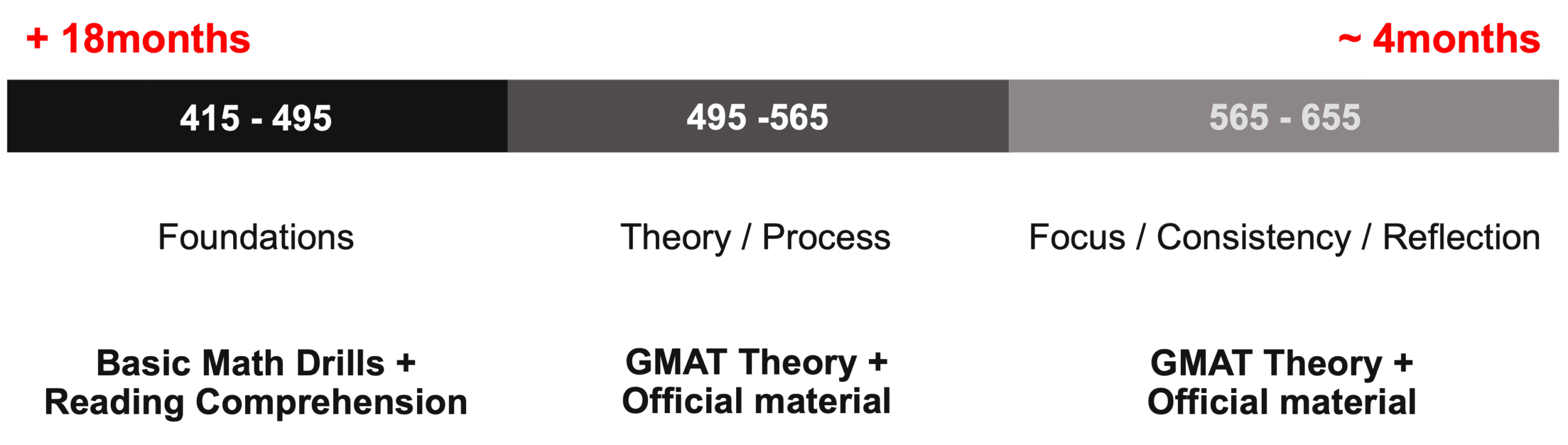
There are some exceptions, but they’re not very common.
The Importance of Being Consistent
When you’ve identified your goal and created a study plan, the next thing you need to do is be consistent. And I’m going to tell you why.
Imagine that you’re pushing a boulder up a hill for some time, and then you stop. That boulder is going to fall back down the hill and you’re going to have to start again. That’s wasted time and energy.
Let me tell you why this is particularly bad for the GMAT.
Official GMAT Materials and Their Purpose
A very essential part of preparation is the usage of official GMAT material. This includes the official GMAT guide, the extra guides you can buy for quant, verbal and data insights, the online question banks you can purchase, and the six official GMAT mock tests.
That seems like a lot of material, but it’s actually not if you’re very far away from the score you want to achieve.
Why Official Materials Are for Assessment, Not Learning
The purpose of these questions in the official material is not to learn the content. You don’t want to use that material to learn about work-rate-time, number properties, or probability. That is not what they are for.
If you’re using that material to learn about all these concepts, you’re wasting it.
The Value of Newness
The main value of these questions is that they are an assessment of whether you are actually learning the skills that allow you to be efficient in how you reason. This is a timed test. It is not about being able to solve a question correctly. It is about being able to solve that question correctly in, on average, two minutes. And that makes a whole world of difference.
The value of these questions is their newness. The first time you see a question, that shock of the new is what you’re trying to experience as often as you can to assess whether the skills you’re learning and the way you’re studying are actually working.
The Space Test
Are you able to solve these questions in a space no larger than this paragprah? Based on my experience, the vast majority of GMAT questions can be solved on a space no larger than this. Your job when studying is to go from solving on an A4-sized paper to solving in only this much space. That is what you’re trying to learn. That is where the magic happens.
These questions allow you to assess whether you’re actually making these changes.
Why Stopping Wastes Resources
When you study and push the boulder up a hill for a few weeks or months, occasionally using these questions as an assessment, and then you stop studying, you’re going to recede. These skills require constant pressure and challenge to develop and maintain.
When you stop and recede, you don’t only waste your time and energy. You’ve also wasted a lot of the value you derive from these official resources because they’re no longer 100% new.
Summary: Clear Objective and Consistency
That is why when you begin to study for the GMAT, the two things you need to remember are: have a clear objective based on your strengths and weaknesses. That’s why you need a diagnostic relatively soon—it allows you to create a study plan.
If that study plan is very long, and based on the diagnostic you decide you need to prepare for a long time, I recommend breaking down that preparation into sprints. This makes it easier for you to stay consistent.
Because if it’s a very large goal, it becomes harder to be consistent. It becomes hard to understand whether whatever you’re doing is working.
And when you’re not consistent, you waste a lot of the material.
Another piece of advice: pick a time in your life when everything is in order and you know that when you commit, you’re going to finish.
How to Actually Study: The Four Phases
Now we get to the actual business of how you study for the GMAT.
To answer this question, I’ll tell you first that generally speaking, there are always four things you want to be doing when you’re preparing. Based on where you are in your preparation, you focus on one more than the others.
| SPRINT FOCUS | WHAT RESOURCE | WHY | HOW |
|---|---|---|---|
| Foundation | Basic math drills | Building blocks without which there’s no progress | short bursts – 10 or 20 minute quizzes. |
| Concepts | GMAT course | Youtube | Understand the framework used to create GMAT questions | In short bursts with exercises to apply. Requires frequent revisiting |
| Reasoning | GMAT questions | GMAT courses | Learn reasoning behind GMAT questions and to improve big picture thinking | Learn from others. Hard to figure out on your own |
| Efficiency and Form | GMAT solutions | Better time management, fewer careless errors | Learn from others. Hard to figure out on your own |
This video describes the outline of how you can study for the gmat and how to move through the phases described below:
Phase 1: Foundations
The first is foundations—the basics. The ultimate foundation is your comprehension of the English language. Reading comprehension.
I’m not talking about the reading comprehension question type. I’m talking about the actual act of reading words in English, parsing that text, and understanding the meaning as it is intended to be understood based on how the question is designed.
This is extremely important because how fast and how precisely you understand information determines the outcome. That is the absolute most essential skill.
If that skill is not really strong, it requires a lot of volume of high-quality questions to improve. And people respond to this phase in different ways.
The second thing under foundations is the understanding you have of the basics of math. For example, solving a linear equation, the multiplication table, exponents, fractions, decimals—the absolute basics.
Ask yourself: Do you have to think a lot when you’re solving linear equations, or do the rules of algebra come to you naturally?
That foundation also requires a lot of work if you’re not already there.
Phase 2: Concepts
After that comes concepts: work-rate-time, number properties, percentages, etc. That’s the second phase.
Phase 3: Reasoning
Very adjacent to concepts is your ability to apply these concepts within the context of a GMAT question. For that, you use principles of reasoning. We have quantitative reasoning, verbal reasoning, and logical reasoning.
I think you’ll agree that what I’ve described so far—foundations, concepts, principles of reasoning—they’re very closely related. There’s a lot of overlap.
Phase 4: Efficiency and Form
And then the last phase, which is I would say the hardest, is one you cannot really extract value from if you don’t have very strong foundations, concepts, and reasoning: efficiency.
The idea is to go from writing this much to writing this much. You want to be efficient in how you reason.
Efficiency requires a lot of iteration and can be challenging. That’s perhaps when a tutor could be helpful. They can show you whether you’re making progress and whether you’re thinking in the correct way.
One of the harder things when you’re learning a skill you’re not already really good at is understanding whether what you’re doing is actually working.
There’s a lot of value in using AI and using Claude and ChatGPT, but it’s very difficult to assess whether what they’re telling you is actually going to work.
The kind of progress you’re looking for when preparing for the GMAT is very often not linear. You can gain a lot from asking a tutor whether this plan makes sense, whether what you’re doing is working, and if not, how you can make a change.
Understanding the Phases and Autonomy
When you’ve decided to prepare, you need to be aware of all these phases: foundations, concepts, reasoning, efficiency. There’s a lot of overlap obviously.
What Is Autonomy?
When you think about concepts, reasoning, and efficiency, they’re very closely related to this idea of autonomy. For example, when you’re reading a long quant problem-solving question, how do you know how to translate what you’re reading into an equation? What is it that you actually do to perform that task?
That requires a lot of experience. It’s really a consequence of solving so many problems to develop the intuition to know: perhaps this is the path I need to take based on my experience.
The Purpose of Official Resources
Which brings me back to the value of official resources. The official GMAT resources are not to learn the content. They are to assess whether what you’re doing is actually working as far as being efficient in how you solve.
What to Do When You Sit Down to Study
When you’re preparing and you understand which phase you’re in, you’ll be able to understand what resources to use in which phase. I’m going to describe the general idea and then we can go into the details.
To answer the question “How do you actually study for the GMAT?” — when you actually sit down to study, what do you do? That is the goal of this guide. By the end, you will understand what to do for the whole duration, for the week, for the hour, and the actual study session. When you sit down to study, you will know exactly what you have to do.
The Study Process and Assessment Schedule
Generally speaking, here’s the process of how you actually study when you have a very long preparation ahead—let’s say, eight months.
During those eight months, based on what we said, you focus on different tasks. For every one of these tasks, there’s a different resource you would use. You want to create a balance where you’re using a certain resource and occasionally you use the official GMAT resources as an assessment to know whether what you’re doing worked.
The assessment ideally should happen every four to eight weeks because you need to put in some time to actually effect change in how you perform and solve problems under timed conditions.
You don’t want to assess every day or every week. Every day is not a good assessment. You want to assess every certain number of weeks to determine whether you’re actually making progress. The best assessment is official GMAT resources—either the official guide or an official GMAT mock test.
Example: Eight-Month Preparation Structure
If you think about the whole phase of preparation and for the sake of argument, let’s say you decided you needed to study for eight months—that’s four phases where the first two months are foundation, then concepts, then applying reasoning principles, and then working on efficiency.
As we said, there’s overlap. You’ll focus on one more than the others in each phase, but you will brush up on these ideas, these tasks, these functions you’re trying to improve within a sprint.
Over the eight-month preparation plan, even though in the first two months you’re focused on building your foundations, you do want to know concepts, reasoning, efficiency, and autonomy. But the focus needs to be one.
Why Foundations Must Come First
Because if your foundations are extremely weak—if you struggle to understand the language you’re reading—your understanding and appreciation of the concepts is going to be limited. Your ability to apply the principles of reasoning as you interpret and solve a question (autonomy) is going to be limited, and you’re not going to be efficient.
For you to be efficient at reasoning, you need to understand the classical forms of solving problems. You need to be able to do the hard way before you appreciate the creative or clever way that allows you to be efficient.
Why Some Students Struggle
That’s why some people really struggle with preparation and get frustrated. They try so many different tools and it’s not really working. It just depends on which phase you’re in.
If you’re focusing on strategies, hacks, tips and tricks, and your foundation is really weak, they’re not going to work. They only work for someone who’s already really good.
You just get into a cycle where it’s extremely frustrating, and you have to build foundations before you make progress.
The other reason is that the progress you’re looking for is not linear. Maybe you’re reading success stories, how people talk about this test, and you feel frustrated because you’re not seeing the progress other people are experiencing. The reason is progress is not linear, and you really have to build your foundations before you move on to the next phases. People react to information differently. That is another part about this test that is extremely challenging.
Resources to Use by Phase
Now you know these are the phases you have to prepare for. You have foundations, learning concepts, the principles of reasoning, efficiency. These are related to the idea of autonomy—that you are able to intuitively figure out what is the next step. That intuition comes from building all these tools we talked about.
Foundation Phase: 70% Non-Official Materials
When you’re in the foundation phase, what tools and resources do you use? The vast majority of your work needs to be on the absolute basics.
You’re reading a lot of reading comprehension passages, a lot of critical reasoning passages that are not the official GMAT guide passages.
Now it’s a different story if you’re like: I don’t really care. I just need to take the test as soon as I can, and it doesn’t matter what score I get. Then fine, focus on the GMAT resources.
But if you’re really trying to make a huge jump in your score, you need to only use the official GMAT resources when you’re in a position to extract value out of them. You have to develop all these ideas we discussed before you focus more of your work on the official GMAT resources.
When you’re in the foundation phase, you’re solving a lot of math drills—multiplication, solving linear equations, doing reading comprehension with resources that are not official GMAT resources—in order to build that foundation.
You want to build that foundation because when we talk about autonomy, you want to be extremely autonomous in how you solve problems when you’re solving GMAT official questions. Otherwise, we don’t extract the most value.
Resource balance: 70% non-official materials, 30% official GMAT questions for occasional assessment.
Concept Phase: 50/50 Split
In the second phase—concepts—this is where a course can be valuable. You’re watching videos on YouTube, talking to a tutor, watching videos on my platform. That is when you learn the concepts.
But the point is this: Your understanding of the concepts needs to be impeccable. You really have to understand the concepts on a very high level.
Resource balance: 50% concept learning materials (courses, videos), 50% official GMAT questions to see how concepts are tested.
The Repetition Principle
When you’re looking at a course and a table of contents, the vast majority of courses are linear in the sense that you go through the table of contents. What I want to say is this: If you’re not already someone who’s good at math or verbal reasoning, going through concept videos and table of contents just once is not enough.
You have to repeat and revisit concepts so many times until they are assimilated. You need to be able to actually summon the underlying snippets and principles within each concept.
The idea is that you want to assimilate these concepts so well—the little snippets and principles under each concept—that they can be summoned as you’re solving almost on autopilot without having to think about them.
Examples of Assimilated Concepts
I use a lot of examples. One example I like to give is this: If I tell you that I divide an integer by 4, do you agree that the remainder has to be less than or equal to 3? If you think about it, you realize this is actually true.
Or another one: two consecutive integers share no common factor between them other than the integer 1. Maybe you’ll sit down and derive it, or when you think about it, you’ll agree with it. But it’s a world of difference to be able to summon that little snippet or principle under time. That is what you’re trying to achieve.
When you’re reviewing concepts, it is not enough to revisit a concept once. You have to revisit concepts so many times.
The Exercise Routine Analogy
The idea I want to impart is this: What you’re trying to do is very similar to committing to an exercise routine. You want to improve your physical fitness and you have a list of exercises you want to do. You go to the gym and do them. Is that enough? Are you done? No. You have to repeat them so many times. How often and how many times you have to repeat them depends on your current fitness level.
The GMAT is exactly the same. That is what you have to remember. Perhaps this allows you to understand why you are struggling to make progress if you haven’t been.
You have to repeat these concepts so many times, solve so many questions—not GMAT questions—in order to arrive at mastery of these concepts so that they are assimilated.
The Language Learning Analogy
An analogy I like to use is this: We are communicating in the English language. The point is communicating ideas in real time. For us to be able to do that, we had to repeat the rules so many times until they were assimilated in order for us to be able to communicate in real time.
The idea is a lot of repetition. That is why you need to split your preparation into all these phases.
Reasoning Phase: 60% Official Materials
When you’ve improved concepts, then you move on to the ideas of reasoning. You’re thinking about minimum, maximum, mutually exclusive sets, and all these different principles related to quantitative and verbal reasoning and logical reasoning that allow you to pull all of this together in order to solve.
Resource balance: 40% non-official materials, 60% official GMAT questions as you develop reasoning patterns.
Efficiency Phase: 80% Official Materials
Then ultimately you’re looking at efficiency. These phases progress. They build on top of each other.
When you’re in the foundation phase, you’re focusing on basic questions that build this foundation. Then you’re focusing on concepts—watching courses, videos, solving a lot of problems. Again, the main balance is not GMAT problems.
Then you’re in the phase when you’re thinking about quantitative reasoning, verbal reasoning, logical reasoning, building autonomy. The balance can be a little bit more of using GMAT questions.
Then the last phase is you’re working on efficiency, trying to perfect your efficiency.
Resource balance: 80% official GMAT materials, 20% targeted practice for specific weaknesses.
Creating Your Study Routine
When you sit down to actually study, you need to have the resource clear. You have to have a drill routine for all the exercises you want to repeat, and then you repeat them on a regular basis until you’re able to do them without having to think about them. That is the measure of progress.
Within each one of those phases, the drills you commit to have to be absolutely clear. So you write down: these are the drills you have to do for all of these things. Then you go through these drills to improve those skills we discussed.
How to Assess Your Readiness
Here’s the question: Does that mean you’re ready? How do you assess? You solve GMAT questions from the official guide or from the extra guides under time conditions. You always have to solve them under time conditions. The first contact with an official GMAT question has to be under time conditions, otherwise you lose the value.
Then you make an assessment: Am I actually able to solve it in, on average, two minutes? You make that assessment and also you’re framing all the ideas you learned within the context of how a GMAT question needs to be solved. That is why you have to exercise a lot of care in how you solve them.
The Danger of Cloned Questions
That is also the danger of using a lot of test prep material. Companies clone the official GMAT questions. They clone the questions in the mock tests. So that newness, that cleverness, that nuance in the question that makes it difficult—you will experience it on non-official questions. And then it degrades the value of official GMAT problems. That’s why you have to be absolutely careful about what resources you use.
Within-Sprint Assessment
Within a sprint, what are the things you’re trying to do? You’re trying to assess whether you built the skill for which that specific phase was designed. When you commit to the routine, the way you do that is within the context of the GMAT question. You do it under time conditions and then you learn how to frame.
Maybe towards the end of the sprint, you take a GMAT mock test and assess: did I make progress? Sometimes you don’t make progress, sometimes you do.
That’s why you have to be really careful how you use these resources.
Maximizing Your Official Materials
If budget is not an issue, remember that the GMAT—now you can take it as many times as you want. Ideally you don’t want to, but there are six official GMAT mock tests that you can repeat twice. With certain conditions, it may feel like an absolute brand new mock test.
You can take the GMAT a few times. If you strategize, all this material can help you make the progress you want—if you’re very clear and very aware about the things you’re actually trying to work on.
Focus and Balance
As we said, in every one of those phases, when you think about how to study, you’re going to sit down, focus on these skills, commit to a drill routine, and be consistent.
The way you know these are the things you need to work on is because you did that diagnostic. Then you do a little bit of the others—you learn concepts, work on reasoning, work on efficiency—but ultimately the balance, the huge load, is on the foundation.
Towards the end, you take a mock test. I think this is an ideal way to go about it because it really is, I find, very close to how our bodies react to exercise.
The Triathlon Analogy
What you’re trying to do is improve your physical fitness or your skill at a certain sport. What matters is: where are you now?
If you’re trying to improve your performance in a triathlon and you don’t know how to swim, well, first you need to learn how to swim. Then if you learn how to swim, you need to improve your stroke. Then you need to improve your fitness.
Maybe for the first part, you’re actually trying to improve your core more. You’re trying to perhaps lose a little bit of weight instead of focusing on the efficiency of your stroke. The efficiency of my stroke—I would focus on that after I learn how to swim a little bit.
That is really generally the idea of how you should approach the GMAT test. And therefore starting early is actually really valuable.
Frequently Asked Questions
How long should I study for the GMAT?
If you’re scoring in the middle range (around 500-550) and targeting a 90th percentile score (645+), expect to study for at least 8 months. This is an honest benchmark based on working with hundreds of students. For smaller improvements of 30-50 points, 3-4 months may be sufficient. Anyone promising dramatic score improvements in just a few weeks isn’t giving you genuine advice—there are exceptions, but they’re rare.
When should I take a GMAT diagnostic test?
Take an official GMAT practice test within the first 1-3 weeks of starting your preparation. Don’t wait until you feel “ready”—you need to understand how you actually reason under timed conditions to create an effective study plan. Delaying the diagnostic too long risks committing to a study plan that isn’t ideal for your actual skill level.
Should I use official GMAT materials from day one?
No. Official GMAT materials (the official guides, question banks, and mock tests) should be used primarily for assessment, not for learning content. If you’re far from your target score and trying to make a huge jump, preserve the “newness” of these materials. Build your foundations with non-official resources first, then use official materials every 4-8 weeks to assess whether your skills are actually developing.
How often should I take GMAT practice tests?
Take a full official GMAT practice test every 4-8 weeks. This gives you enough time between assessments to actually implement changes and develop skills. Assessing more frequently (daily or weekly) doesn’t allow sufficient time for meaningful improvement and wastes your limited official practice tests.
What if I’m not making progress on the GMAT?
First, assess which phase you’re truly in. Are you trying to work on efficiency strategies when your foundations are still weak? That won’t work—efficiency techniques only help students who already have strong foundations. Also remember that GMAT progress is not linear. Different people progress at different rates based on their backgrounds and learning styles. If you’re genuinely stuck after 8-12 weeks in a phase without progress, consider getting expert guidance to identify what’s blocking your improvement.
Can I study for the GMAT while working full-time?
Yes, but you need to pick a period when your work is stable and predictable. Be realistic about how many hours per week you can study consistently. It’s better to study 10-15 hours weekly for 8 months and finish than to attempt 30 hours weekly, burn out after 2 months, and have to restart (which wastes your official materials).
What are the 4 phases of GMAT preparation?
The four phases are: (1) Foundations—building reading comprehension and basic math skills; (2) Concepts—learning GMAT-specific topics like work-rate-time, number properties, and grammar rules; (3) Reasoning—developing quantitative, verbal, and logical reasoning to apply concepts within GMAT questions; (4) Efficiency—learning to solve in minimal time and space. Each phase builds on the previous one, and you cannot skip foundations to jump straight to efficiency.
Why do you recommend breaking preparation into sprints?
Breaking a long preparation timeline (like 8 months) into 8-12 week sprints makes it easier to stay consistent. With one massive long-term goal, it’s hard to gauge whether what you’re doing is working, which makes it difficult to maintain motivation. Sprints give you regular assessment points to measure progress and adjust your approach. Each sprint should focus on building specific skills, end with a practice test, and lead into the next sprint with clear objectives.
What does “autonomy” mean in GMAT preparation?
Autonomy is the ability to intuitively know what approach to take when you read a complex GMAT question. For example, when you see a long problem-solving question, how do you know how to translate it into equations? Autonomy develops from solving many problems and building pattern recognition. It’s the difference between mechanically following steps and fluidly knowing the right path based on experience.
Ready to Start Your GMAT Preparation?
Now that you understand how to study for the GMAT with a structured 4-phase approach, you’re ready to begin.
Next steps:
- Take an official GMAT diagnostic test within the next 1-3 weeks
- Assess realistically how far you are from your target score
- Choose a study plan that matches your timeline and phase
- Commit to consistency throughout your preparation
Need help getting started? Work with a GMAT tutor who can assess your specific situation and create a personalized preparation strategy.
Looking for structured study plans? Check out our proven study plan templates for different timelines and student backgrounds.